



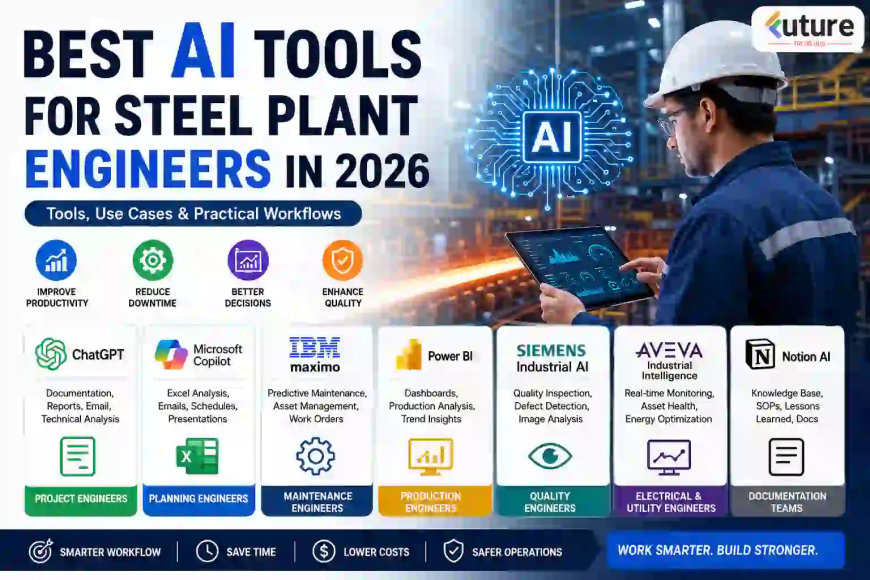
Best AI Tools for Steel Plant Engineers in 2026: Tools, Use Cases & Practical Workflows
Discover the best AI tools for steel plant engineers in 2026. Learn practical use cases, workflows, examples, benefits, limitations, and how AI improves productivity, maintenance, quality, and project execution.
Best AI Tools for Steel Plant Engineers in 2026: Tools, Use Cases & Practical Workflows
Introduction
Steel plants produce enormous amounts of information every day.
Maintenance records, shutdown schedules, project documents, equipment parameters, inspection reports, and production data continuously move across departments. Engineers often spend more time searching information, preparing reports, and coordinating activities than actually solving technical problems.
This is where AI tools for steel plant engineers can make a measurable difference.
AI cannot replace engineering judgment, but it can reduce repetitive work, improve decision-making, identify patterns, and increase productivity.
In this guide you will learn:
- Best AI tools for steel plant engineers in 2026
- Which tool is useful for which department
- Real use cases
- Practical workflows
- Common mistakes
- Limitations and future trends
Why Steel Plant Engineers Need AI Tools
Typical engineering activities in steel plants include:
- Equipment troubleshooting
- Daily reporting
- MOM preparation
- Shutdown planning
- Root cause analysis
- Quality inspections
- Production monitoring
- Vendor coordination
Common challenges:
- Too much manual documentation
- Difficulty analyzing large datasets
- Unplanned breakdowns
- Communication delays
- Repetitive tasks
AI tools can reduce these challenges.
AI Tools and Their Practical Use Cases in Steel Plants
Tool #1: ChatGPT for Project Engineers and Documentation
Best for:
- Project engineers
- Maintenance engineers
- Managers
- Site engineers
Use cases:
✓ MOM report generation
✓ Technical email drafting
✓ Root cause analysis assistance
✓ Method statement preparation
✓ Technical specifications
✓ Vendor comparison
Practical workflow
Meeting discussion
↓
Meeting notes
↓
AI prompt
↓
MOM report
↓
Review and send
Example
A weekly project review meeting discusses:
- Pump installation delay
- Foundation issue
- Electrical cable routing
Prompt:
"Create a MOM report with action items, responsible persons, and target dates."
Output:
| Discussion | Action | Responsible |
|---|---|---|
| Foundation issue | Correct alignment | Civil Team |
| Cable routing | Complete work | Electrical Team |
Benefits
- Faster documentation
- Better formatting
- Time savings
Limitation
AI can misunderstand technical terms if prompts are unclear.
Tool #2: Microsoft Copilot for Office Productivity
Best for:
- Planning engineers
- Managers
- Project teams
Use cases
✓ Excel analysis
✓ PowerPoint generation
✓ Email summaries
✓ Schedule tracking
✓ Meeting notes
Practical workflow
Excel production data
↓
Copilot analyzes trends
↓
Automatic summary
↓
Management presentation
Example
Production data from 30 days uploaded to Excel.
AI identifies:
- Production decline
- Shift-wise variation
- Delay trend
Benefits
- Saves office work time
- Improves reporting speed
Limitation
Requires organized input data.
Tool #3: IBM Maximo for Predictive Maintenance
Best for:
- Mechanical engineers
- Reliability engineers
- Maintenance teams
Use cases
✓ Failure prediction
✓ Asset monitoring
✓ Maintenance scheduling
✓ Spare planning
Practical workflow
Equipment sensors
↓
AI analysis
↓
Abnormal pattern detection
↓
Maintenance alert
Steel plant example
Continuous casting machine motor shows:
- Higher vibration
- Temperature increase
- Current rise
AI output:
"Potential bearing failure risk detected."
Maintenance action:
Schedule replacement before failure.
Benefits
- Reduced downtime
- Lower maintenance cost
Limitation
Requires sensor integration.
Tool #4: Power BI AI Features for Production Engineers
Best for:
- Production engineers
- Process engineers
- Plant managers
Use cases
✓ Dashboard creation
✓ Production trend analysis
✓ Downtime analysis
✓ Energy monitoring
Practical workflow
Production database
↓
Dashboard generation
↓
AI identifies trends
↓
Action plan
Steel plant example
Rolling mill data analysis reveals:
- Higher downtime during Shift B
- Increased rejection rate
Benefits
- Faster decision-making
- Better visualization
Limitation
Data quality affects accuracy.
Tool #5: Siemens Industrial AI for Quality Inspection
Best for:
- Quality engineers
- Process teams
Use cases
✓ Surface defect detection
✓ Image inspection
✓ Dimensional checking
✓ Product quality monitoring
Practical workflow
Camera image
↓
AI analysis
↓
Defect detection
↓
Inspection report
Steel plant example
Rail manufacturing line:
AI detects:
- Surface cracks
- Scratches
- Dimensional variations
Benefits
- Faster inspection
- Reduced human error
Limitation
Needs large training datasets.
Tool #6: AVEVA Industrial Intelligence for Process Monitoring
Best for:
- Electrical engineers
- Utility engineers
- Process engineers
Use cases
✓ Real-time monitoring
✓ Energy optimization
✓ Equipment health analysis
✓ Alarm management
Practical workflow
Sensor data
↓
AI processing
↓
Performance analysis
↓
Alert generation
Steel plant example
Descaling pump motor:
AI detects:
- Increased power consumption
- Current imbalance
- Temperature rise
Benefits
- Early warning system
- Reduced failures
Limitation
High initial implementation cost.
Tool #7: Notion AI for Knowledge Management
Best for:
- Project teams
- Documentation teams
Use cases
✓ SOP generation
✓ Knowledge database
✓ Lessons learned records
✓ Daily logs
Practical workflow
Engineering notes
↓
AI categorization
↓
Searchable knowledge base
Benefits
- Better information retrieval
- Organized documentation
Quick Selection Guide: Which Engineer Should Use Which Tool?
| Engineer Type | Recommended Tool | Main Purpose |
|---|---|---|
| Project Engineer | ChatGPT | MOM and documentation |
| Mechanical Engineer | IBM Maximo | Predictive maintenance |
| Production Engineer | Power BI | Trend analysis |
| Quality Engineer | Siemens AI | Defect detection |
| Electrical Engineer | AVEVA | Equipment monitoring |
| Planning Engineer | Copilot | Reports and schedules |
| Documentation Team | Notion AI | Knowledge management |
Pro Tip: Create an AI Prompt Library
Save frequently used prompts.
Examples:
MOM Prompt
"Generate MOM with action items and deadlines."
Root Cause Prompt
"Analyze probable causes for hydraulic pressure drop in descaling pump."
Technical Email Prompt
"Write email regarding delayed motor delivery."
Safety Prompt
"Generate Job Safety Analysis for pump maintenance activity."
Common Mistakes Engineers Make
Blindly trusting AI output
Always verify:
- Equipment specifications
- Drawings
- Technical calculations
Using poor prompts
Poor:
"Explain motor problem."
Better:
"Analyze possible causes of high vibration in rolling mill motor."
Uploading confidential information
Avoid uploading:
- Contract documents
- Client data
- Proprietary drawings
Ignoring site conditions
AI recommendations may not consider actual plant conditions.
Future Trends of AI in Steel Plants
Expected developments include:
- Digital twins
- Autonomous inspection robots
- Real-time predictive maintenance
- AI-assisted shutdown planning
- Energy optimization systems
- Smart production scheduling
FAQ
Which AI tool is best for project engineers in steel plants?
ChatGPT is useful for MOM reports, documentation, and technical communication.
Which AI tool predicts machine failures?
IBM Maximo and industrial predictive maintenance platforms can detect abnormal equipment behavior.
Can AI reduce steel plant downtime?
Yes. Predictive maintenance systems help identify problems before failures occur.
Can AI improve product quality?
Yes. AI vision systems can identify defects automatically.
Can small steel plants use AI?
Yes. Smaller plants can start with productivity tools before investing in larger industrial systems.
Can AI replace maintenance engineers?
No. AI assists decision-making but does not replace technical expertise.
6. Key Takeaways
- Different AI tools solve different engineering problems.
- ChatGPT helps documentation and communication.
- Predictive maintenance tools reduce breakdowns.
- Power BI improves production analysis.
- Quality inspection becomes faster with AI vision systems.
- Human verification remains essential.
Read Also >>
25 ChatGPT Prompts Every Project Engineer Should Save in 2026
How Engineers Can Create MOM Reports in Minutes Using AI
What's Your Reaction?
 Like
0
Like
0
 Dislike
0
Dislike
0
 Love
0
Love
0
 Funny
0
Funny
0
 Angry
0
Angry
0
 Sad
0
Sad
0
 Wow
0
Wow
0