






Can AI Help Mechanical Engineers in Design Work? Complete Practical Guide for 2026
Can AI help mechanical engineers in design work? Discover practical AI tools, workflows, use cases, examples, limitations, and how AI can improve CAD design, calculations, simulations, and engineering productivity in 2026.
Can AI Help Mechanical Engineers in Design Work? Complete Practical Guide for 2026
Introduction
Mechanical design work is changing quickly.
Earlier, engineers spent hours creating concepts, preparing drawings, calculating dimensions, checking standards, and modifying designs after review comments. Today AI tools are starting to assist in many of these activities.
Many mechanical engineers have one question:
Can AI actually help in design work, or is it just another trend?
The short answer is yes — AI can help. But not in the way many people imagine.
AI does not replace engineering knowledge. It works more like an intelligent assistant that speeds up repetitive tasks and supports decision-making.
In this guide you will learn:
- How AI helps mechanical engineers in design work
- Best AI tools and their use cases
- Practical workflows
- Industry examples
- Limitations
- Future trends
Why Mechanical Engineers Are Using AI
Mechanical design engineers usually work on:
- CAD modeling
- Design calculations
- Material selection
- Simulation
- Design modifications
- BOM preparation
- Manufacturing documentation
- Standards checking
Common problems:
- Repetitive modeling
- Time-consuming calculations
- Multiple revisions
- Documentation effort
- Design optimization challenges
AI helps reduce repetitive work and improves productivity.
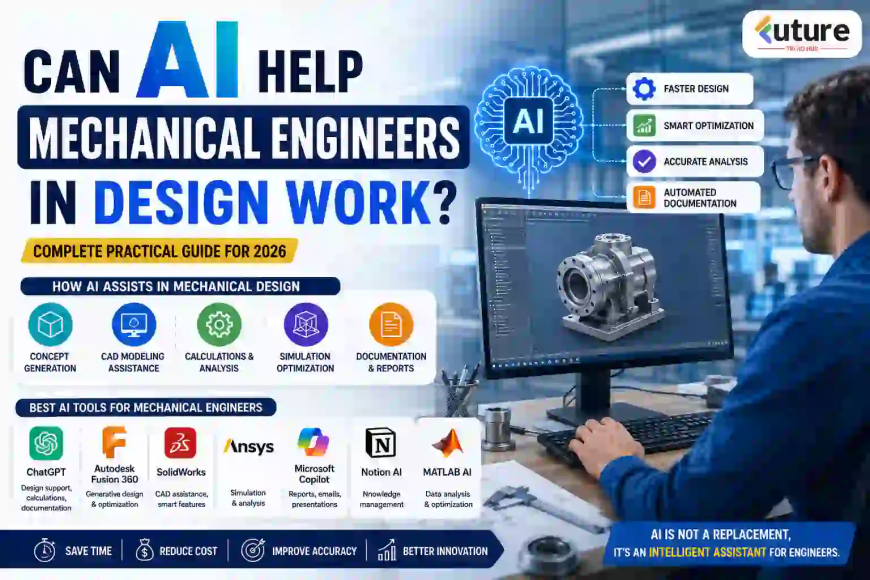
Best AI Tools for Mechanical Design Engineers and Their Use Cases
| Tool | Main Purpose | Best For |
|---|---|---|
| ChatGPT | Design support and calculations | Mechanical engineers |
| Autodesk Fusion AI Tools | Generative design | Product designers |
| SolidWorks AI Solutions | Design assistance | CAD engineers |
| Microsoft Copilot | Documentation and reporting | Project teams |
| ANSYS AI Solutions | Simulation optimization | Analysis engineers |
| MATLAB AI Tools | Data analysis and optimization | R&D teams |
| Notion AI | Knowledge management | Design teams |
AI Tool #1: ChatGPT for Daily Mechanical Design Work
Best for:
- Design calculations
- Technical documentation
- Design brainstorming
- Material comparison
- Root cause analysis
Practical use cases
✓ Generate calculation steps
✓ Draft technical emails
✓ Create design checklists
✓ Explain standards
✓ Compare materials
Workflow
Design requirement
↓
Prompt AI
↓
Generate ideas
↓
Engineering verification
↓
Final design
Example
Requirement:
"Design support frame for 2-ton equipment."
Prompt:
"Suggest possible structural sections and material options for a 2-ton equipment support frame."
Possible AI output:
- ISMB sections
- Square tube structures
- Material suggestions
Engineer then validates through calculations.
Limitation
AI may provide unrealistic assumptions if input requirements are incomplete.
AI Tool #2: Generative Design for Component Optimization
Recommended Tool:
Generative design uses AI to create multiple design options automatically.
Inputs:
- Material
- Load conditions
- Constraints
- Manufacturing process
Workflow
Load requirements
↓
AI generates multiple designs
↓
Engineer selects design
↓
Optimization
Practical example
Traditional bracket:
- Weight = 8 kg
AI optimized design:
- Weight = 5.5 kg
Possible benefits:
- Material saving
- Lower cost
- Better performance
AI Tool #3: AI for CAD Modeling Assistance
Recommended Tool:
Use cases
✓ Smart sketch suggestions
✓ Design modifications
✓ Assembly support
✓ Automatic feature recognition
Practical workflow
2D sketch
↓
AI recognizes geometry
↓
Suggested features
↓
3D model generation
Industry example
Machine base design:
Instead of manually creating repeated hole patterns:
AI suggests automated patterns.
Benefits:
- Faster design
- Reduced repetitive work
AI Tool #4: AI for Simulation and Analysis
Recommended Tool:
Use cases
✓ Stress analysis
✓ Thermal analysis
✓ Fluid flow analysis
✓ Design optimization
Workflow
CAD model
↓
Simulation setup
↓
AI prediction
↓
Optimized design
Practical example
Pressure vessel design:
AI predicts:
- High stress areas
- Material optimization opportunities
- Structural weaknesses
AI Tool #5: AI for Documentation and Reporting
Recommended Tool:
Use cases
✓ MOM reports
✓ Design reports
✓ Excel summaries
✓ Presentation generation
Workflow
Design data
↓
AI summary
↓
Report generation
↓
Review
Practical Industry Scenario: Machine Design Project
Suppose a mechanical engineer needs to design a conveyor structure.
Traditional process
Requirement
↓
Manual calculations
↓
CAD model
↓
Simulation
↓
Documentation
↓
Review
Time: 3–5 days
AI-assisted process
Requirement
↓
AI design suggestions
↓
Generative design
↓
Simulation assistance
↓
Auto documentation
↓
Final engineering review
Time may reduce significantly.
How AI Helps in Different Mechanical Engineering Fields
| Field | AI Use |
|---|---|
| Machine Design | Design optimization |
| Manufacturing | Process improvement |
| Maintenance | Failure prediction |
| HVAC | Energy optimization |
| Projects | Documentation |
| Quality | Defect analysis |
| Automotive | Weight reduction |
Pro Tip: Create a Personal Engineering Prompt Library
Examples:
Design Prompt
"Suggest material options for high-temperature conveyor rollers."
Calculation Prompt
"Provide calculation approach for foundation bolts of 20-ton equipment."
Material Prompt
"Compare SS304 and SS316 for corrosive environment."
Email Prompt
"Write technical clarification email for design approval."
Common Mistakes Mechanical Engineers Make with AI
Blindly accepting AI output
Always verify:
- Design assumptions
- Material properties
- Standards
- Safety factors
Using vague prompts
Poor prompt:
"Design a bracket."
Better prompt:
"Suggest bracket design for supporting 500 kg load with safety factor 3."
Ignoring manufacturing constraints
AI may suggest designs that are difficult to fabricate.
Skipping engineering calculations
AI suggestions are not substitutes for engineering validation.
Limitations of AI in Mechanical Design
| Limitation | Impact |
|---|---|
| Missing design inputs | Incorrect output |
| No real-world context | Practical issues |
| Manufacturing limitations | Difficult fabrication |
| Standards interpretation errors | Wrong design decisions |
| Lack of engineering judgment | Reliability concerns |
Future Trends of AI in Mechanical Design
Future developments may include:
- Voice-based CAD design
- Automatic drawing generation
- Real-time design optimization
- AI-generated simulations
- Smart digital twins
- Automated BOM generation
- AI-assisted manufacturing planning
FAQ
Can AI design mechanical components automatically?
AI can generate concepts and optimize designs, but engineers still validate and approve them.
Can AI replace mechanical design engineers?
No. AI assists engineers rather than replacing technical expertise.
Which AI tool is useful for CAD engineers?
Fusion AI tools and SolidWorks AI features can assist with design tasks.
Can AI perform engineering calculations?
AI can support calculations, but outputs should always be verified.
Can AI reduce design time?
Yes. AI can reduce repetitive work and improve productivity.
Is AI useful for beginners in mechanical engineering?
Yes. It can help explain concepts, calculations, and workflows.
Read Also >>
How Mechanical Engineers Can Use ChatGPT Daily in 2026
25 ChatGPT Prompts Every Project Engineer Should Save in 2026
Best AI Tools for Steel Plant Engineers in 2026
What's Your Reaction?
 Like
0
Like
0
 Dislike
0
Dislike
0
 Love
0
Love
0
 Funny
0
Funny
0
 Angry
0
Angry
0
 Sad
0
Sad
0
 Wow
0
Wow
0