





How Mechanical Engineers Can Use ChatGPT Daily in 2026: Practical Workflows, Examples, Prompts and Limitations
Learn how mechanical engineers can use ChatGPT daily for calculations, design reviews, maintenance, documentation, troubleshooting, reports, learning, and productivity with practical workflows, examples, limitations, and FAQs.
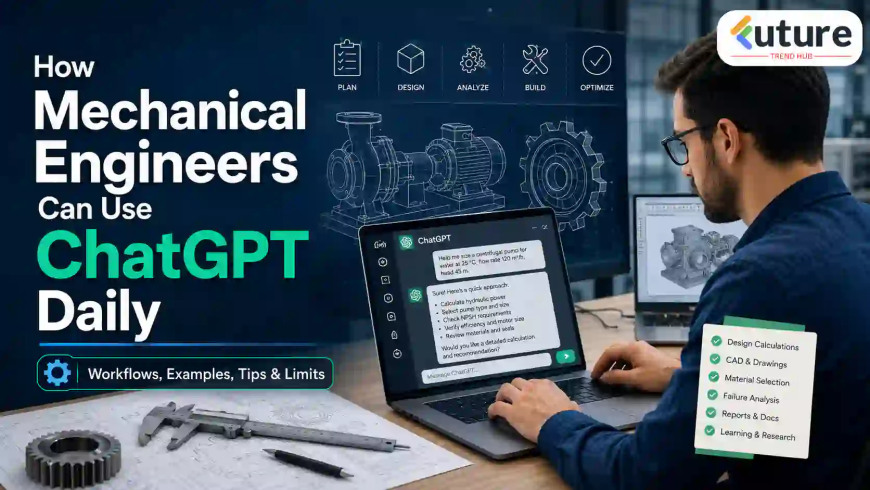
How Mechanical Engineers Can Use ChatGPT Daily in 2026: Practical Workflows, Examples and Limitations
Mechanical engineers handle many things in one day: drawings, calculations, vendor emails, inspection reports, equipment problems, maintenance planning, project updates, datasheets, manuals, and technical discussions.
The problem is not always lack of knowledge. The real issue is time.
This is where ChatGPT for mechanical engineers becomes useful. It can help engineers think faster, organize technical information, prepare documents, analyze data, understand standards, review drawings, and create practical workflows. ChatGPT can also analyze uploaded files, images, diagrams, screenshots, spreadsheets, and documents depending on the available features in the user’s plan and workspace. OpenAI’s help documentation describes support for file uploads, data analysis, image understanding, and document-based tasks.
But there is one important point.
ChatGPT is not a replacement for engineering judgment, design responsibility, safety review, or certified calculations. It is a productivity assistant. Used correctly, it can save hours. Used blindly, it can create serious errors.
In this guide, you will learn how mechanical engineers can use ChatGPT daily in real work, with examples, workflows, prompts, limitations, common mistakes, and future trends.
1. Why ChatGPT Matters for Mechanical Engineers
Mechanical engineering is a practical field. Engineers work with machines, materials, tolerances, loads, motors, pumps, compressors, conveyors, pressure vessels, HVAC systems, steel structures, piping, utilities, and production equipment.
Daily work often includes:
- Understanding technical documents
- Preparing reports
- Reviewing drawings
- Making calculations
- Comparing vendor offers
- Troubleshooting equipment
- Writing emails
- Creating checklists
- Preparing SOPs
- Explaining technical issues to non-technical teams
ChatGPT can help in all these areas.
It is especially useful when the engineer knows the subject but needs help with structure, speed, clarity, or second-level thinking. For example, a maintenance engineer may already know why a pump is vibrating, but ChatGPT can help create a systematic troubleshooting checklist.
Practical example
Instead of asking:
Why pump vibration happens?
Ask:
Act as a mechanical maintenance engineer. Create a troubleshooting checklist for high vibration in a centrifugal pump. Include possible causes, inspection points, required tools, and corrective actions.
This gives a more practical answer.
2. Daily Use Cases of ChatGPT for Mechanical Engineers
Mechanical engineers can use ChatGPT in different roles. A design engineer may use it differently from a maintenance engineer or project engineer.
| Engineering Role | Daily ChatGPT Use |
|---|---|
| Design Engineer: | Concept explanation, calculation review, material comparison, drawing checklist |
| Maintenance Engineer: | Troubleshooting, failure analysis, preventive maintenance plans |
| Project Engineer: | MOM, progress reports, WBS, risk registers, vendor communication |
| Production Engineer: | Process improvement, downtime analysis, SOPs |
| Quality Engineer: | Inspection checklists, NCR analysis, root cause analysis |
| Procurement Engineer: | Technical bid comparison, vendor query preparation |
| Site Engineer: | Installation procedures, commissioning checklists, safety notes |
The best use of ChatGPT is not “give me an answer.” The better use is “help me structure my engineering thinking.”
3. ChatGPT for Engineering Calculations
Mechanical engineers frequently perform calculations related to load, pressure, torque, flow, stress, power, efficiency, and safety factors. (Engineering Calculator)
ChatGPT can help with:
- Formula selection
- Unit conversion logic
- Step-by-step calculation format
- Spreadsheet formula creation
- Calculation report preparation
- Checking whether assumptions are reasonable
But the final number must always be verified.
Example: Pump Power Calculation
Prompt:
Act as a mechanical engineer. Calculate pump motor power for water flow of 100 m³/hr, head 50 m, pump efficiency 70%, motor efficiency 90%. Show formula, unit conversion, and final recommended motor rating.
ChatGPT can structure the calculation like this:
| Input | Value |
|---|---|
| Flow | 100 m³/hr |
| Head | 50 m |
| Fluid | Water |
| Pump efficiency | 70% |
| Motor efficiency | 90% |
It can then explain hydraulic power, shaft power, and motor input power.
Best practice
Use ChatGPT to create the calculation format. Then verify using:
- Your company standard
- Relevant design code
- Manufacturer catalogue
- Senior engineer review
- Approved software
- Manual recalculation
Important limitation
Do not use ChatGPT alone for final design of:
- Pressure vessels
- Lifting beams
- Foundation bolts
- Structural supports
- Crane components
- Safety-critical systems
- High-pressure piping
- Fire protection systems
For these, ChatGPT can support the workflow, but certified engineering verification is mandatory.
4. ChatGPT for Drawing Review and Design Checklists
Mechanical engineers spend a lot of time reviewing drawings. These may include GA drawings, fabrication drawings, piping layouts, equipment foundations, machine assemblies, and vendor drawings.
ChatGPT can help create review checklists.
Example prompt
Create a mechanical drawing review checklist for a fabricated trolley of size 800 mm × 500 mm × 900 mm. Include material, welds, dimensions, wheel selection, handle height, load capacity, painting, and safety points.
Possible checklist output:
| Review Point | What to Check |
|---|---|
| Overall dimension | Length, width, height as per requirement |
| Material | MS square pipe, plate, angle, or channel |
| Welding | Continuous weld, intermittent weld, fillet size |
| Wheels | Load capacity, swivel/fixed type, brake requirement |
| Handle | Ergonomic height and grip |
| Load rating | Static and dynamic load capacity |
| Finish | Primer, paint, powder coating |
| Safety | Sharp edge removal, stability, anti-topple design |
Industry scenario
A project engineer receives a vendor GA drawing for a lifting trolley. Instead of manually preparing comments from scratch, the engineer can ask ChatGPT to generate a review template. Then the engineer fills actual observations after checking the drawing.
This saves time and improves consistency.
5. ChatGPT for Maintenance Troubleshooting
Maintenance teams can use ChatGPT as a diagnostic assistant. It cannot inspect the machine physically, but it can help organize probable causes.
Common mechanical problems where ChatGPT helps
- Pump vibration
- Bearing overheating
- Gearbox noise
- Hydraulic pressure drop
- Pneumatic cylinder slow movement
- Compressor trip
- Conveyor belt misalignment
- Motor coupling failure
- Excessive oil leakage
- Abnormal machine noise
Example: Gearbox Overheating Workflow
Prompt:
Act as a mechanical maintenance engineer. Prepare a troubleshooting workflow for gearbox overheating in an industrial conveyor system. Include possible causes, inspection method, corrective action, and urgency level.
Output can be organized like this:
| Possible Cause | Inspection Method | Corrective Action | Urgency |
|---|---|---|---|
| Low oil level | Check sight glass/dipstick | Refill correct grade oil | High |
| Wrong oil grade | Verify oil specification | Replace with recommended oil | High |
| Overload | Check motor current and load | Reduce load or inspect jam | High |
| Bearing failure | Check noise/vibration/temp | Replace bearing | Critical |
| Misalignment | Check coupling alignment | Realign drive system | Medium |
| Poor ventilation | Inspect cooling path | Clean fins/fan area | Medium |
Pro Tip
Ask ChatGPT to separate mechanical, electrical, process, and operator-related causes. This gives a better troubleshooting structure.
6. ChatGPT for Engineering Documentation
Documentation is one of the most useful areas for ChatGPT.
Mechanical engineers often need to write:
- Technical emails
- Inspection reports
- Commissioning reports
- Work completion reports
- Method statements
- SOPs
- MOM
- Risk assessments
- Vendor clarification letters
- Technical comparison sheets
- Delay justification letters
ChatGPT can improve clarity and professionalism.
Example: Technical Email
Prompt:
Rewrite this email professionally for a client. Keep the meaning same. Make it polite but firm. Mention that cable size appears underrated for the CNC machine and needs review before full load operation.
This is useful because engineers often know the issue but need help presenting it clearly.
Example: Commissioning Report Structure
Prompt:
Create a commissioning report format for a hydraulic power pack. Include equipment details, pre-commissioning checks, no-load trial, load trial, observations, pending points, and sign-off section.
ChatGPT can generate a structured report format within seconds.
Practical advice
Do not copy-paste confidential project details into public AI tools unless your company policy allows it. Remove sensitive information such as:
- Client name
- Project number
- Commercial values
- Proprietary drawings
- Passwords
- Personal data
- Confidential contract clauses
7. ChatGPT for Root Cause Analysis and Problem Solving
Mechanical engineers often use structured problem-solving tools like:
- 5 Why Analysis
- Fishbone Diagram
- CAPA
- RCA
- FMEA
- Pareto Analysis
- 8D Report
- PDCA
- Kaizen
- Six Sigma tools
ChatGPT can help build the first draft.
Example: 5 Why Analysis
Problem:
Bearing failed repeatedly in a conveyor drive pulley.
Prompt:
Prepare a 5 Why Analysis for repeated bearing failure in a conveyor drive pulley. Include possible root causes, validation method, corrective action, and preventive action.
Possible output:
| Why | Answer |
|---|---|
| Why did the bearing fail? | Bearing overheated and seized. |
| Why did it overheat? | Lubrication was insufficient. |
| Why was lubrication insufficient? | Greasing schedule was not followed or grease path was blocked. |
| Why was it not detected? | No temperature monitoring or PM checklist was used. |
| Why was PM weak? | Maintenance plan did not include bearing temperature and lubrication verification. |
Corrective actions may include bearing replacement, grease path cleaning, lubrication schedule revision, technician training, and thermal inspection.
Best use
Use ChatGPT to create possible causes. Then validate with actual evidence:
- Vibration data
- Temperature record
- Oil/grease condition
- Alignment report
- Load data
- Maintenance history
- Operator feedback
8. ChatGPT for Vendor Comparison and Procurement Support
Mechanical engineers often support purchase teams. They compare technical offers, datasheets, catalogues, and deviations.
ChatGPT can help create comparison tables.
Example prompt
Compare two technical offers for an industrial air compressor. Create a technical comparison table with capacity, pressure, motor rating, cooling type, dryer, filter, control system, warranty, deviations, and missing information.
Useful output format
| Parameter | Vendor A | Vendor B | Comment |
|---|---|---|---|
| Capacity | 500 CFM | 480 CFM | Vendor A higher |
| Pressure | 8 bar | 8 bar | Same |
| Motor rating | 75 kW | 75 kW | Same |
| Dryer included | Yes | No | Commercial impact |
| Warranty | 18 months | 12 months | Vendor A better |
| Deviation list | Provided | Not provided | Need clarification |
Important caution
ChatGPT can help compare information only if the uploaded or pasted data is accurate. It may miss hidden commercial or contractual risks. Always check:
- Scope exclusions
- Warranty terms
- Delivery schedule
- Performance guarantee
- Installation scope
- Commissioning support
- Spares
- After-sales service
- Payment terms
- Penalty clauses
9. ChatGPT for Learning and Skill Development
Beginners and intermediate engineers can use ChatGPT as a learning assistant.
It can explain:
- Mechanical design basics
- Thermodynamics
- Fluid mechanics
- Strength of materials
- Manufacturing processes
- GD&T
- Welding symbols
- Bearings
- Pumps
- Compressors
- Hydraulic systems
- CNC machines
- Industrial maintenance
- Project management
Better learning prompt
Instead of:
Explain GD&T.
Ask:
Explain GD&T for a beginner mechanical engineer with simple examples from a machined shaft and bearing housing. Include common symbols and practical inspection meaning.
This produces a more job-relevant explanation.
Learning workflow
- Ask for a simple explanation.
- Ask for a real industrial example.
- Ask for common mistakes.
- Ask for a checklist.
- Ask for interview questions.
- Ask for a small case study.
- Verify with textbooks, standards, or senior engineers.
10. ChatGPT for Data Analysis and Reports
Mechanical engineers often handle data from production, maintenance, quality, and project progress.
Examples include:
- Breakdown hours
- MTBF and MTTR
- Pump performance readings
- Energy consumption
- Production loss
- Inspection results
- Vibration readings
- Temperature trends
- Maintenance cost
- Project progress data
ChatGPT can analyze spreadsheets and create tables or charts when data analysis features are available. OpenAI’s documentation notes that ChatGPT can analyze uploaded files, answer questions about data, and generate tables or charts when useful.
Example prompt for maintenance data
Analyze this breakdown data. Find top 5 equipment causing maximum downtime. Calculate downtime percentage, suggest Pareto observations, and recommend maintenance actions.
Example output
| Equipment | Downtime Hours | Percentage | Suggested Action |
|---|---|---|---|
| Compressor-1 | 42 | 28% | Check PM quality and spares |
| Pump-3 | 31 | 21% | Review seal failure pattern |
| Conveyor-2 | 25 | 17% | Inspect belt alignment |
| Cooling Tower Fan | 18 | 12% | Check bearing and vibration |
| Hydraulic Unit | 15 | 10% | Check oil contamination |
Practical benefit
This helps engineers convert raw data into decision-making information.
11. Pro Tip: Use ChatGPT as a Workflow Builder, Not Just an Answer Machine
The biggest mistake is asking one-line questions and expecting perfect answers.
Better approach:
Weak prompt
Make SOP for pump.
Strong prompt
Act as a mechanical maintenance engineer. Create an SOP for safe start-up, operation, and shutdown of a centrifugal pump handling water. Include PPE, pre-start checks, valve position, motor start, pressure monitoring, abnormal conditions, shutdown steps, and emergency response.
This gives a much better result.
Prompt formula for mechanical engineers
Use this structure:
Act as a [role].
Prepare [required output].
For [equipment/system/process].
Include [specific points].
Format as [table/checklist/report/email].
Mention assumptions and limitations.
Example
Act as a project mechanical engineer. Prepare a commissioning checklist for a 50 kVA voltage stabilizer supplying a CNC horizontal machining center. Include cable inspection, earthing, input voltage, output voltage, load trial, safety checks, and documentation.
12. Common Mistakes Mechanical Engineers Should Avoid
Mistake 1: Trusting ChatGPT without verification
ChatGPT may produce confident but incorrect answers. Always verify critical outputs.
Mistake 2: Giving incomplete input
If you do not provide equipment details, operating conditions, material, load, pressure, temperature, or standards, the answer will remain generic.
Mistake 3: Using it for final certified design
It should not replace licensed engineering review, statutory approval, or code-based design validation.
Mistake 4: Ignoring company standards
Every organization has its own formats, safety rules, and approval process. Use ChatGPT output as a draft, not as final authority.
Mistake 5: Uploading confidential data carelessly
Do not share sensitive project, client, or commercial information unless your company policy permits it.
Mistake 6: Asking vague questions
Bad prompt:
Tell about bearing.
Good prompt:
Explain why spherical roller bearings are used in conveyor pulleys. Include load type, misalignment, lubrication, failure modes, and maintenance checks.
13. Limitations of ChatGPT in Mechanical Engineering
ChatGPT is useful, but it has boundaries.
| Area | Limitation |
|---|---|
| Engineering calculations | May make formula or unit mistakes |
| Standards | May not always reflect latest code revision |
| Drawings | May miss small visual details or hidden assumptions |
| Safety-critical design | Cannot replace certified engineer approval |
| Vendor data | Cannot verify unless actual datasheet is provided |
| Site troubleshooting | Cannot inspect physical condition |
| Legal/contract matters | Needs expert review |
| Cost estimation | Needs updated market rates and local inputs |
For current technical standards, vendor prices, product availability, or regulatory changes, engineers should verify with official sources, standards bodies, OEM manuals, and project-approved documents.
14. Future Trends: AI in Mechanical Engineering
AI tools are moving from simple text generation to more advanced engineering support.
Some likely trends:
1. AI-assisted design review
Engineers may use AI to check drawings, BOMs, tolerances, and inconsistencies faster.
2. Predictive maintenance support
AI may help analyze vibration, temperature, current, and oil analysis data to predict failures.
3. Faster technical documentation
Reports, SOPs, inspection formats, and maintenance plans will become faster to prepare.
4. AI-supported project management
Project engineers can use AI for WBS, delay analysis, risk registers, progress summaries, and vendor follow-up tracking.
5. Engineering research acceleration
OpenAI describes deep research as a ChatGPT capability for complex online research and documented reports, including use cases relevant to engineering knowledge work.
6. Multimodal engineering assistance
The ability to work with text, images, files, charts, and data can help engineers handle mixed technical information more efficiently. OpenAI’s ChatGPT capability overview describes image analysis, file uploads, data analysis, and voice mode as supported capability areas.
15. FAQ: How Mechanical Engineers Can Use ChatGPT Daily
1. Can mechanical engineers use ChatGPT for calculations?
Yes, mechanical engineers can use ChatGPT to structure calculations, explain formulas, check logic, and create calculation templates. However, final engineering calculations must be verified manually or through approved software, especially for safety-critical applications.
2. Is ChatGPT useful for mechanical design engineers?
Yes. It can help create design checklists, compare materials, explain mechanisms, prepare drawing review points, draft technical notes, and organize design assumptions. It should not replace CAD validation, FEA, design codes, or senior engineering review.
3. Can ChatGPT review mechanical drawings?
ChatGPT can help review drawing information if details are provided or if image/file analysis is available. It can create checklists and identify possible review points. But final drawing approval must be done by qualified engineers.
4. How can maintenance engineers use ChatGPT?
Maintenance engineers can use it for troubleshooting guides, preventive maintenance schedules, root cause analysis, spare parts planning, SOPs, breakdown reports, and equipment failure checklists.
5. Can ChatGPT write technical reports?
Yes. It can draft inspection reports, commissioning reports, work completion reports, MOMs, technical emails, method statements, and risk assessments. The engineer must check all facts before submission.
6. Is ChatGPT safe for confidential engineering projects?
It depends on company policy and the platform configuration. Avoid uploading confidential drawings, contracts, client documents, or commercial data unless your organization allows it and the tool environment is approved.
7. Can ChatGPT replace mechanical engineers?
No. ChatGPT can support engineering work, but it cannot replace field judgment, design accountability, safety responsibility, physical inspection, statutory approval, or professional engineering experience.
8. What is the best way to ask ChatGPT engineering questions?
Give role, context, equipment details, operating conditions, required output format, assumptions, and expected level of detail. Specific prompts produce better engineering answers.
Key Takeaways
- ChatGPT can help mechanical engineers with calculations, reports, troubleshooting, documentation, design checklists, data analysis, and learning.
- It works best when used as a workflow assistant, not as a final authority.
- Mechanical engineers should always verify calculations, standards, safety points, and vendor data.
- Good prompts produce practical outputs. Vague prompts produce generic answers.
- The strongest use cases are documentation, troubleshooting structure, RCA, checklists, comparison tables, and learning support.
- For safety-critical design, ChatGPT output must be reviewed by qualified engineers and approved methods.
Read Also >>
25 ChatGPT Prompts Every Project Engineer Should Save in 2026
How Engineers Can Create MOM Reports in Minutes Using AI
What's Your Reaction?
 Like
0
Like
0
 Dislike
0
Dislike
0
 Love
0
Love
0
 Funny
0
Funny
0
 Angry
0
Angry
0
 Sad
0
Sad
0
 Wow
0
Wow
0