









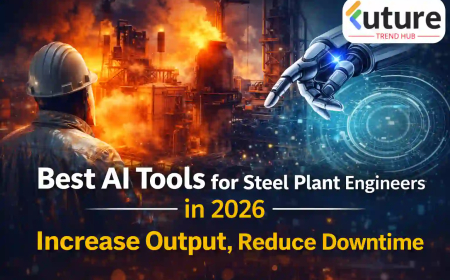




















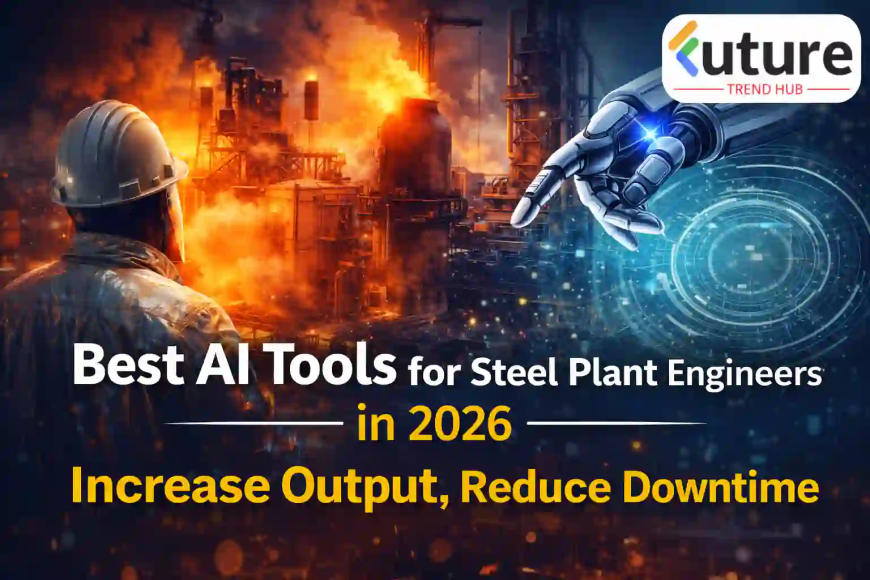
Best AI Tools for Steel Plant Engineers in 2026: Increase Output, Reduce Downtime
Discover the best AI tools for steel plant engineers in 2026. Learn how to improve production, maintenance, and efficiency with practical insights and real-world examples.
Best AI Tools for Steel Plant Engineers in 2026: Increase Output, Reduce Downtime
Introduction
Let’s be honest… steel plant me kaam karna is not easy. High temperature, continuous production pressure, strict quality control, and zero tolerance for downtime — everything runs on precision.
Whether you are handling a blast furnace, rolling mill, or utility system, one small issue can affect the entire production line.
This is exactly where AI tools for steel plant engineers are changing the game.
In real life, I have seen engineers struggling with:
- Unexpected equipment failures
- Manual data analysis
- Delayed decision-making
But jo engineers smart tools use karte hain, they get faster insights, better control, and fewer breakdowns.
In this article, you will learn:
- Best AI tools used in steel plants
- How they improve production and maintenance
- Practical examples from industry
- Future trends you should prepare for
Let’s dive in.
Why Steel Plant Engineers Need AI Tools Today
Steel plants are complex systems. Thousands of parameters run simultaneously — temperature, pressure, speed, load, vibration, etc.
From my experience:
- Manual monitoring is not enough
- Small deviations go unnoticed
- Maintenance is often reactive, not proactive
AI tools help by:
- Monitoring data in real time
- Predicting failures before they happen
- Optimizing production parameters
Simple language me:
“Problem hone se pehle warning mil jaye — that’s the real power.”
Top AI Tools for Steel Plant Engineers in 2026
1. Siemens MindSphere (Industrial IoT Platform)
This is one of the most powerful platforms for industrial data.
Key features:
- Real-time equipment monitoring
- Cloud-based analytics
- Predictive maintenance
Real-world example:
In a rolling mill, vibration data was analyzed using this platform. Bearing failure was predicted 10 days in advance — downtime avoided.
2. IBM Maximo (Maintenance Management Tool)
Maintenance is the backbone of any steel plant.
What it offers:
- Asset lifecycle management
- Work order automation
- Failure prediction
From my experience, proper maintenance planning can increase equipment life significantly.
3. AspenTech (Process Optimization Tool)
Used widely in heavy industries.
Benefits:
- Process simulation
- Energy optimization
- Production improvement
Example:
Blast furnace fuel consumption reduced by optimizing input parameters.
4. SparkCognition (Predictive Analytics Tool)
This tool focuses on predictive maintenance and anomaly detection.
Key advantages:
- Detects abnormal patterns
- Predicts equipment failures
- Improves plant reliability
In simple terms, it acts like a “health monitoring system” for machines.
5. ABB Ability (Smart Automation Platform)
A complete digital solution for industrial plants.
Features:
- Equipment monitoring
- Remote operation
- Performance optimization
Kaafi plants me use ho raha hai for centralized control systems.
6. Uptake (Industrial Intelligence Platform)
Focused on improving asset performance.
What it does:
- Identifies performance gaps
- Provides actionable insights
- Reduces unplanned downtime
7. MATLAB + AI Toolboxes (Advanced Analysis)
For engineers who work on data and modeling.
Use cases:
- Data analysis
- Predictive modeling
- Control system design
Agar aap technical analysis me interested ho, this is very powerful.
8. Python-Based Tools (Custom Solutions)
Many engineers are now using Python for custom automation.
Applications:
- Data analysis
- Dashboard creation
- Process optimization
From my experience, even basic Python knowledge can give you a strong advantage.
9. Drone + AI Inspection Tools
Inspection in steel plants is risky.
With drones:
- Safer inspections
- Faster data collection
- High-quality visuals
Used for chimneys, conveyors, and large structures.
How AI Tools Improve Steel Plant Operations
Let’s break it down practically.
1. Predictive Maintenance
- Failure before failure
- Less downtime
- Better planning
2. Production Optimization
- Better output
- Reduced waste
- Energy savings
3. Quality Control
- Defect detection
- Consistent product quality
4. Safety Improvement
- Hazard detection
- Reduced manual risk
In short:
Efficiency + Safety + Cost saving = Better plant performance
How to Choose the Right Tool
Every engineer does not need every tool.
Maintenance Engineer:
- IBM Maximo
- SparkCognition
Production Engineer:
- AspenTech
- ABB Ability
Automation Engineer:
- Siemens MindSphere
- Python tools
Inspection Team:
- Drone tools
Simple approach:
“Identify your biggest challenge, then pick the tool.”
Pro Tip (From Industry Experience)
Start with data.
Many plants have data but don’t use it properly.
Better approach:
- Collect proper data
- Clean and organize it
- Then apply tools
Without good data, even the best tool will fail.
Common Mistakes Engineers Make
Let’s talk reality.
1. Ignoring data quality
Wrong data = wrong decisions
2. Overcomplicating things
Simple solutions often work better
3. Not involving operators
Ground-level feedback is critical
4. No proper training
Tool use karna aana chahiye
5. Expecting instant results
These tools need time to show impact
Future Trends in Steel Industry (Very Important)
The next decade will transform steel plants completely.
1. Fully Automated Plants
Minimal human intervention
Machines + smart systems handle operations
2. Digital Twins
Virtual replica of plant
Real-time monitoring and simulation
3. Smart Energy Management
Energy optimization will become critical
4. Autonomous Maintenance
Self-diagnosing machines
5. Integrated Smart Supply Chain
From raw material to dispatch — everything connected
Simple words me:
Steel plants will become “intelligent factories.”
FAQs
1. What are the best AI tools for steel plant engineers?
Top tools include Siemens MindSphere, IBM Maximo, AspenTech, ABB Ability, and SparkCognition.
2. How do AI tools help in steel plants?
They help in predictive maintenance, production optimization, and improving safety.
3. Are these tools suitable for beginners?
Yes, many tools are user-friendly. Start with basic platforms and gradually move to advanced ones.
4. Do I need coding knowledge to use these tools?
Not always. But basic knowledge of tools like Python can be helpful.
5. Can AI reduce downtime in steel plants?
Yes, predictive maintenance can significantly reduce unplanned downtime.
Conclusion
Steel industry is evolving fast.
If you continue using only traditional methods, you may struggle to keep up.
But the opportunity is huge.
Start today:
- Learn one tool
- Apply it in your daily work
- Improve step by step
In real life, the difference is clear:
Engineers who adapt grow faster and lead better.
So the question is simple—
Are you ready to upgrade your skills?
What's Your Reaction?
 Like
0
Like
0
 Dislike
0
Dislike
0
 Love
0
Love
0
 Funny
0
Funny
0
 Angry
0
Angry
0
 Sad
0
Sad
0
 Wow
0
Wow
0