

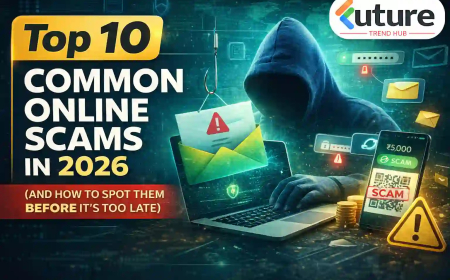























Top 10 Common Online Scams in 2026 (And How to Spot Them Before It’s Too Late)
Discover the top 10 common online scams in 2026 and learn practical ways to identify and avoid them. Stay safe with real-world tips and expert insights.
Let’s be honest—online scams are getting smarter every year. Earlier, you could easily spot a fake email with broken English or weird links. But in 2026, scammers are using advanced tools, AI-generated voices, and even realistic websites that look 100% genuine.
In real life, I’ve seen engineers, business owners, and even tech-savvy people fall into these traps. So it’s not about intelligence—it’s about awareness.
In this article, you’ll learn the top 10 common online scams, how they actually work, and most importantly, how to spot them before they hit you.
1. Phishing Emails – Still the #1 Online Scam
Phishing is one of the oldest tricks, but it’s still very effective.
How it works:
You receive an email that looks like it’s from your bank, company, or even a government portal. It asks you to:
- Click a link
- Enter login details
- Verify your account
Real Example:
From my experience in project environments, I’ve seen fake emails pretending to be from procurement teams asking vendors to “update bank details.”
How to spot:
- Email address looks slightly off
- Urgent language: “Act now” or “Account blocked”
- Suspicious links
Simple rule: Never click links directly—always visit the official website.
2. UPI & Payment App Scams (Very Common in India)
With apps like UPI, payments are instant—but so are scams.
How it works:
- You get a “request” instead of payment
- Scammer calls pretending to be a buyer
- Asks you to “approve” money
Reality check:
Bhai, remember this: You never need to enter a PIN to receive money.
Red flags:
- Unknown payment requests
- QR codes sent by strangers
- Pressure to act quickly
3. Fake Job Offers & Work-From-Home Scams
This one targets freshers and job seekers.
How it works:
- Attractive job offer (high salary, remote work)
- Small “registration fee” or “training fee”
- Then… silence
Example:
A friend once received an “international company offer” without even applying. That’s your first red flag.
How to spot:
- No proper interview process
- Generic email IDs (like Gmail/Yahoo)
- Asking for money upfront
4. OTP & SIM Swap Fraud
This is dangerous because it directly targets your bank account.
How it works:
- Scammer calls pretending to be telecom/bank
- Asks for OTP or SIM details
- Gains control of your number
Real-world scenario:
In industrial sectors, vendors have lost lakhs due to OTP sharing during urgent calls.
Red flags:
- Anyone asking for OTP
- Sudden loss of network (SIM deactivated)
5. Fake E-commerce Websites
Online shopping is convenient—but risky.
How it works:
- Fake website offers huge discounts
- You pay → product never arrives
Let’s be honest:
If something looks too good to be true—it usually is.
How to spot:
- Poor website design
- No customer reviews
- No contact details
6. Investment & Crypto Scams
This is booming in 2026.
How it works:
- “Guaranteed returns” schemes
- Fake trading platforms
- Influencer-style promotions
Reality:
No genuine investment guarantees profit. Zero.
How to spot:
- Unrealistic returns (e.g., double money in 10 days)
- Pressure to invest quickly
- Unknown platforms
7. Social Media Impersonation
Scammers create fake profiles of your friends or colleagues.
How it works:
- Fake account sends message: “I need urgent help”
- Requests money transfer
Real example:
In companies, fake profiles of managers have been used to trick employees.
How to spot:
- New account with few posts
- Different writing style
- Asking for urgent money
8. Tech Support Scams
You might see a popup: “Your system is infected.”
How it works:
- Fake warning message
- Toll-free number
- They ask for remote access
Reality:
No real company will call you like this.
Red flags:
- Sudden pop-ups
- Unknown support numbers
- Asking for remote access
9. Loan & Credit Scams
Very common in financial stress situations.
How it works:
- Instant loan approval
- No documents required
- Advance fee demanded
Practical insight:
In real life, legit banks NEVER ask for upfront fees.
How to spot:
- No proper documentation
- WhatsApp-based loan offers
- Urgency tactics
10. Deepfake & AI Voice Scams (Emerging Threat)
This is next-level fraud.
How it works:
- AI-generated voice of someone you know
- Calls asking for urgent help or money
Example:
Imagine hearing your boss’s voice asking for payment approval—scary, right?
How to spot:
- Unusual request
- Verify via another channel
- Slight unnatural tone or urgency
Pro Tip: The “Pause & Verify” Rule
Before taking any action online, just pause for 30 seconds and ask:
- Is this expected?
- Is there urgency pressure?
- Can I verify this from another source?
Trust me, this simple habit can save you from 90% of scams.
Common Mistakes People Make
Let’s be real—most scams succeed because of small mistakes:
- Clicking links without checking
- Sharing OTP or PIN
- Trusting unknown callers
- Ignoring gut feeling
- Using same password everywhere
Avoid these, and you’re already ahead of most people.
Future Trends in Online Scams (2026 and Beyond)
This is important.
Scams are evolving fast, especially with technology:
1. AI-powered scams
Scammers are using automation to target thousands of people at once.
2. Deepfake videos & voice
Highly realistic identity theft is becoming common.
3. Personalized phishing
Using your social media data to create believable scams.
4. Business email compromise (BEC)
Targeting companies, vendors, and project teams.
In industries like steel plants, procurement scams and fake vendor emails are already increasing.
So awareness is no longer optional—it’s necessary.
FAQs (Real Search-Based Questions)
1. What are the most common online scams in 2026?
Phishing emails, UPI scams, fake job offers, OTP fraud, and AI-based scams are among the most common.
2. How can I identify a scam quickly?
Look for urgency, unknown sources, requests for sensitive data, and offers that seem too good to be true.
3. Is it safe to share OTP with bank officials?
No. Banks never ask for OTP. Sharing it can lead to account loss.
4. What should I do if I get scammed online?
Immediately:
- Block your bank account
- Report to cybercrime portal
- Inform your bank
5. Are online payment apps safe?
Yes, but only if used correctly. Never approve unknown requests or share PIN.
Conclusion: Stay Alert, Stay Safe
Online scams are not going away—they are evolving.
From my experience, the biggest defense is not technology—it’s awareness. Even highly educated professionals fall for scams when they act in a hurry.
So next time you receive a suspicious message or call, don’t rush.
Think. Verify. Then act.
Because in today’s digital world, a small mistake can cost big.
What's Your Reaction?
 Like
0
Like
0
 Dislike
0
Dislike
0
 Love
0
Love
0
 Funny
0
Funny
0
 Angry
0
Angry
0
 Sad
0
Sad
0
 Wow
0
Wow
0